Traditions
In Diaobé, the Kankurang still walks
Every hivernage — the West African rainy season — a figure clothed in the red fibre of the faara tree comes out into the Manding villages of Senegal and Gambia, in the season of the circumcisions. UNESCO has listed the rite since 2008 — and warned, in the same breath, that it is wearing thin. On 18 September, in Diaobé, the whole neighbourhood came out to meet him.
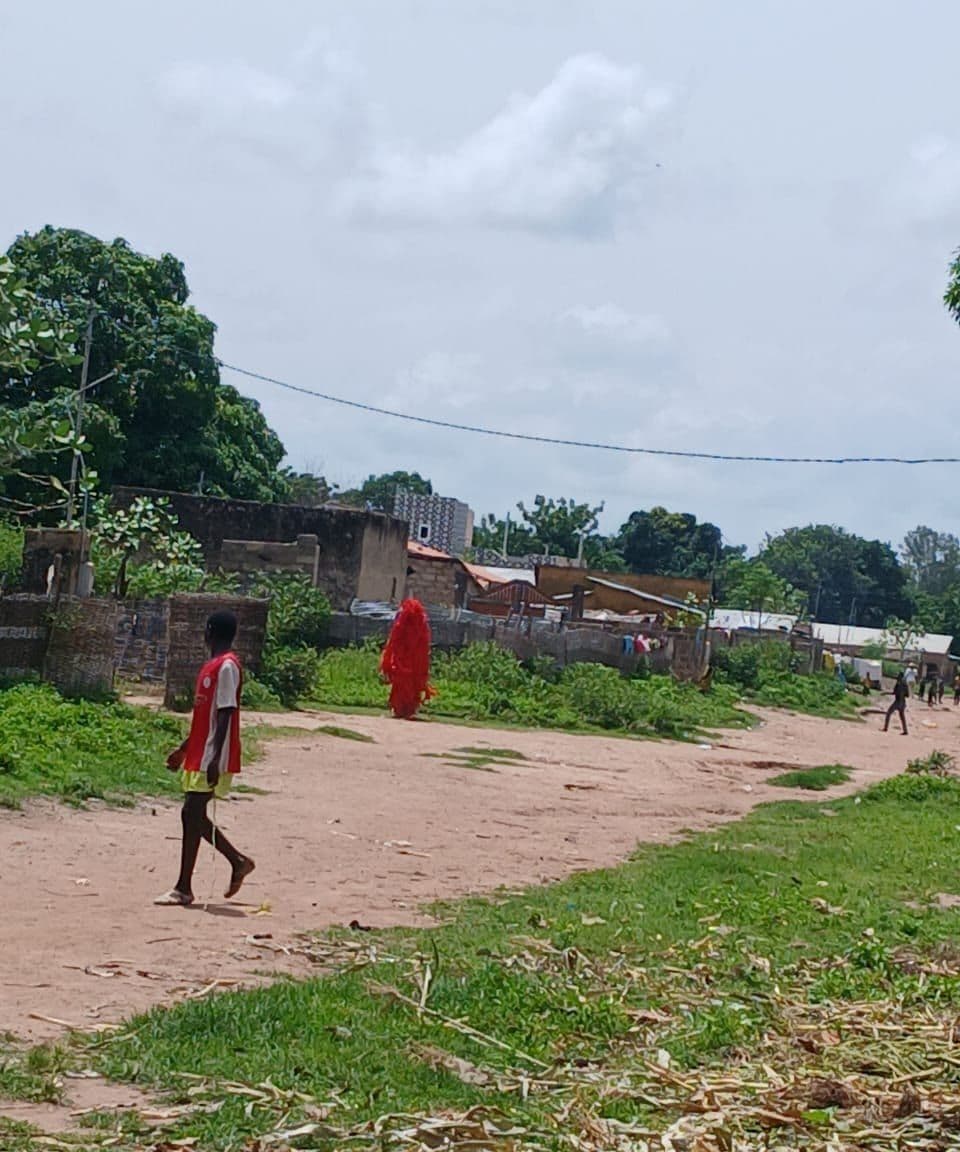
On the sand track, people move to the sides on their own. No one gives an order. At the far end of the path a figure advances, covered head to foot in red fibre, and the children who were running a second earlier stop dead. This is the Kankurang. A mask of bark, and two machetes The Kankurang is not a festival costume. It is an office. The mask is made from the bark and red fibre of the faara tree; the body is clothed in leaves and painted with vegetable dyes. He carries two machetes, and moves surrounded by an escort armed with sticks and rhun palm leaves. He comes out during the hivernage — the rainy season — when the circumcisions of boys take place in the Manding communities of Senegal and Gambia. The procession of 18 September in Diaobé was one of those. For that season, the initiates are in his keeping. He is the one who passes on the community's rules of behaviour, the knowledge of healing plants, the techniques of the hunt. UNESCO describes him in a phrase that says everything: guarantor of order and justice, and exorcist of evil spirits. What these pictures do not show This has to be said plainly: what you see here is the public part. The procession through the streets, the crowd stepping back, the children watching from the roots of the great tree. The initiation itself is not filmed, and is not told. It belongs to those who live it and those who pass it on. Afro Daily Village does not try to enter where it is not invited. We show the street; the rest stays in the village. Four languages, one rite Diaobé is not an isolated village at the end of a track. It is a crossroads town in the Vélingara department, in the Kolda region, some sixty kilometres from Guinea-Bissau. Every Wednesday its weekly market draws traders from Gambia, Guinea-Conakry, Guinea-Bissau, Mali and Burkina Faso. And you can hear it in the streets. Diaobé speaks Pulaar and Mandinka — known here as Socé. To those are added a large Fula community from the Fouta Djallon highlands of Guinea-Conakry, and Diola families. That is exactly what makes the scene remarkable. The Kankurang is a Manding rite. In a town built on trade and passing through, where Mandinka is only one language among four, it would have every reason to fade. A heritage UNESCO calls fragile When UNESCO inscribed the Kankurang on its Representative List in 2008 — after proclaiming it a Masterpiece of the Oral and Intangible Heritage of Humanity in 2005 — it named, in the same breath, what threatens it: rapid urbanisation, and the turning of sacred forests into farmland. The rite is being trivialised, and the Kankurang's authority worn away. And yet in Diaobé, on 18 September 2026, the track emptied of its own accord as the red figure went by. The detail that stays with you In one of the pictures, a boy in a red jersey watches the Kankurang from a distance. He happens to be wearing the same colour. In a few years it may be his turn to be in the mask's keeping. Or the rite will have faded, and he will be telling other children that he once saw something pass along the sand track of his neighbourhood. That is why we film.
Correspondent in Diaobé, Senegal
Amadou Manka
Amadou Manka films and photographs daily life in Diaobé, the town in Upper Casamance where he comes from. His first reporting for Afro Daily Village follows the Kankurang through the streets of his own neighbourhood.
Stories from the village 🌍
New films, new stories and what we found on the road — once a week, in your inbox.
No spam. One click to leave, any time.